Climate change is not expected to affect the extent or frequency of the El Niño/Southern Oscillation over the 21st century, but it could worsen its impacts. That’s the conclusion of a modeling study published in Journal of Climate in September.
A team that includes NCAR scientists Anne Boynard and Alex Guenther has found that the rate at which plant canopies emit isoprene, a volatile organic compound, is influenced by circadian rhythms.
New research that involves NCAR's Bette Otto-Bliesner questions conventional wisdom with regard to massive iceberg discharges in the North Atlantic Ocean during the last glacial period, pointing toward climate rather than ice sheet instability as a cause.
A new study involving NCAR's Bette Otto-Bliesner looks at rising sea levels during the warmth of the last interglacial period (130,000 to 120,000 years ago) and finds that melting ice sheets contributed far more to rising sea levels than thermal expansion.
Prior to massive flooding early in 2011, long-term drought plagued the Australian state of Queensland . As part of a broad research program on cloud seeding, NCAR researchers have been steadily crunching data from a 2008–09 field project that looked into how to make the clouds drop more rain on the region.
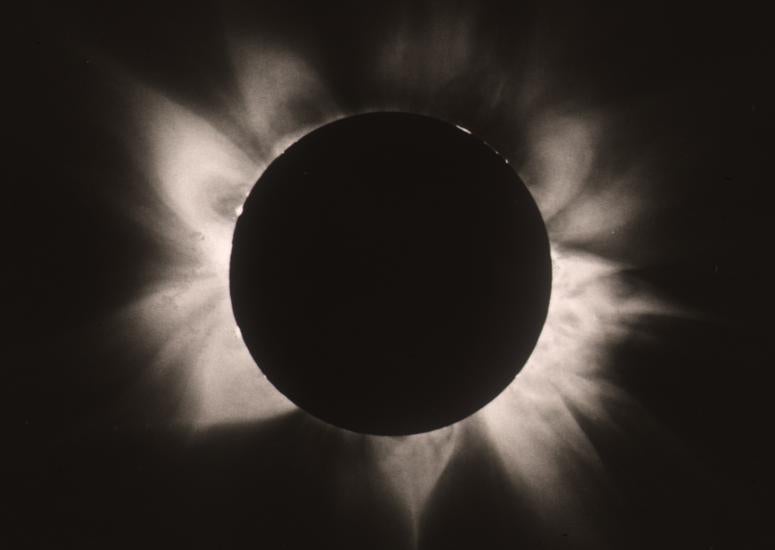
The solar minimum that bottomed out from 2006 to 2010 was the longest and deepest since modern space observations began. Among other effects, it reorganized the areas of flux from open magnetic field lines that produce solar wind. NCAR postdoctoral researcher Liang Zhao is using data from the last two minima to revise a model of how open magnetic flux is transported through the solar atmosphere.
A new study led by NCAR’s Wei Yu and CU-Boulder’s Weiqing Han looks at the effects of the Madden-Julian Oscillation (MJO), the largest source of intraseasonal (within one season) variability in the tropics, causing wet and dry periods to alternate.
A new study looks at how the anticipated recovery of the ozone hole over Antarctica and simultaneous increase in greenhouse gas concentrations will combine to affect weather and climate in the Southern Hemisphere.
Alaska is among the fastest-warming places on Earth, with its interior region warming the most statewide. A study by NCAR’s Shannon McNeeley looks at the vulnerability to climate change of native rural communities.
An international team of astronomers that includes NCAR’s Savita Mathur has observed mixed waves—a mixture of acoustic and gravity waves—that run all the way to the cores of red giant stars. Astronomers already knew that such waves (known as stellar oscillations) existed, but until now had only observed pure acoustic waves traveling through the outer parts of stars.
New research indicates that a regional nuclear war would deplete Earth’s protective ozone layer so profoundly that levels of ultraviolet radiation across the world would exceed levels now considered extreme.
A study led by NCAR postdoctoral researcher Jia Hu and Julia Klein from Colorado State University looks at the relationship between plants, water, carbon, and climate on the Tibetan Plateau, which is warming at a rate twice that of the global average.
Last year, a team of NCAR scientists verified that the Weather Research and Forecasting model (WRF) can be used to depict seasonal snowfall in Colorado with a high degree of accuracy. Now the team is using WRF to forecast future snowfall.
A new study from NCAR uses an innovative computer model to investigate events called sudden stratospheric warmings (SSWs) in the Arctic atmosphere. The study focuses on how two atmospheric patterns based in the tropics, the El Niño–Southern Oscillation and Quasi-Biennial Oscillation, affect SSWs.
A new study by NCAR scientists looks at the accuracy of snow gauges. Making accurate measurements of snowfall is critical for weather forecasting, climate studies, and hydrology. But a combination of snow gauge geometry and weather conditions can lead to systematic measurement errors.
A team of scientists is tackling a scenario that is the stuff of Hollywood thrillers: What happens if a medium-sized asteroid strikes Earth? In particular, what if it crashes into the ocean? The question is not fanciful.
Crop yields are affected by many factors, including breeding, management, and climate. New research from NCAR seeks to better understand these factors and their contributions to historical yield increases, in order to anticipate future changes.
The wolverine is known for its strength and ferocity, but these qualities cannot protect it from a warming world. NCAR research suggests that this aggressive predator may struggle to survive in the contiguous United States over the coming century.
A team of NCAR scientists is studying how advanced satellite technology that measures lightning could help protect aircraft from turbulence caused by severe weather.
El Niño and La Niña are counterparts in the El Niño-Southern Oscillation (ENSO), a cyclic warming and cooling of the eastern and central Pacific Ocean that exerts a major influence on global weather patterns, but they are not mirror images.