International collaboration has always been at the heart of COSMIC, a six-satellite network that intercepts GPS signals to measure weather, climate, and space weather variables. Now one of the leading university collaborators on COSMIC, the University of Graz, is UCAR’s latest international affiliate.
It’s not exactly a moment for celebration, but when a tropical storm is born in the Atlantic, millions of people learn about it quickly. As with any birth, though, a great deal has to happen in just the right way before a tropical storm is christened.
In the spring of 2009, researchers on the Second Verification of the Origins of Rotation in Tornadoes Experiment (VORTEX2) field project set out across the Great Plains to study tornadoes, but that’s not the only phenomenon they observed.
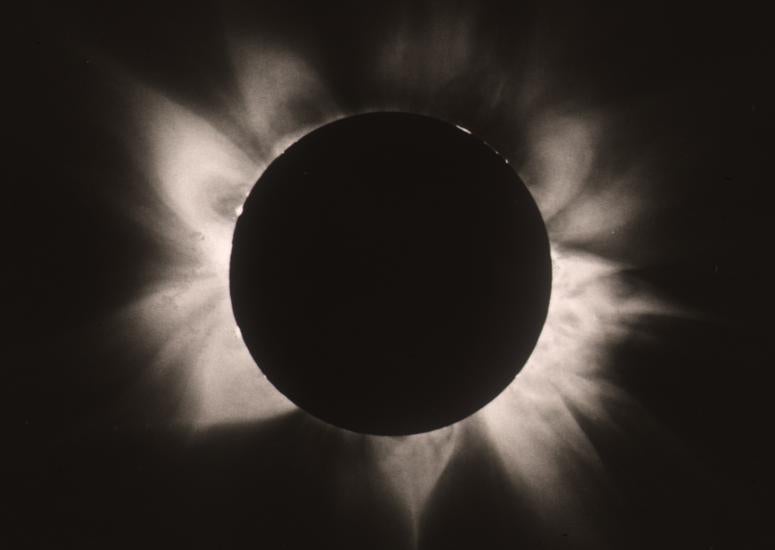
NCAR’s Coronal Multichannel Polarimeter (CoMP) found a new home early this year on Hawaii’s Mauna Loa, a high-elevation paradise for astronomical observers.
Cirrus clouds—thin strands or sheets usually composed of ice crystals—form high in the atmosphere. A new study led by NCAR scientist Steve Massie employs satellite technology to observe the clouds in greater detail than before.
The greater Salt Lake City area is known for harboring some of the most polluted air in the country during the winter. A team of NCAR researchers is gearing up to collaborate on a study of the winter weather inversions that cause the city's poor air quality.
NCAR and university researchers are collaborating with the U.S. Department of Agriculture and Federal Aviation Administration to study how bird-detecting radar at airports could help prevent dangerous airplane bird strikes.
A team led by NCAR's Jim Smith has found that aminium salts make up as much as half of the mass of newly formed particles in places as diverse as Atlanta, Mexico City, northeast Colorado, and Finland.
A collaboration of scientists that includes UCAR's John Braun is pioneering a new technique for using GPS satellite signals to measure snow depth as well as soil and vegetation moisture.
Preliminary research at NCAR suggests that biological particles may contribute significantly to the mass of organic carbon stored in atmospheric aerosols. The study is an important step for scientists.
In 2006, a team of NCAR researchers convened in Mexico City for MIRAGE, a study of the chemical and physical transformation of air pollution in urban areas and its impact on air quality, ecosystems, and climate. Another MIRAGE field campaign kicks off this month, this time in Shanghai, China's largest city.
This spring the second Verification of the Origins of Rotation in Tornadoes Experiment (VORTEX2, or V2) captured one tornado in unprecedented detail, as well as a number of potentially tornadic thunderstorms that never made the grade.
A team of NCAR researchers led by Jacob Fugal is developing and testing a specialized instrument that uses digital holography to measure tiny cloud droplets.
A new study led by NCAR scientist David Edwards is the first to apply the concept of Observing System Simulation Experiments to chemical weather (predicting pollution events and variability in the atmosphere’s chemical composition).
The largest and most ambitious tornado study in history will begin next week, as dozens of scientists deploy radars and other ground-based instruments across the Great Plains to gain a better understanding of these often deadly weather events.
A team of scientists has successfully flown from the Arctic to the Antarctic this month, the first step in a three-year project to make the most extensive airborne measurements of carbon dioxide and other greenhouse gases to date.
In a potential boon for agriculture, a NASA-funded effort that involves NCAR and the private firm DTN/Meteorlogix has produced one of the world’s most accurate systems for predicting soil temperature up to two days in advance.
Research from MIRAGE (Megacities Impacts on Regional and Global Environments), a field campaign held in Mexico City in 2006, is coming to fruition as scientists begin to publish their findings. A new paper details the ozone “weekend effect” in Mexico City and its implications for local air pollution.
Scientists are deploying an advanced research aircraft to study a region of the atmosphere that influences climate change by affecting Earth's thermal balance. Findings will be used to improve computer models of global climate.
The National Hurricane Center will implement a new technique this summer, developed by researchers at NCAR and the Naval Research Laboratory (NRL), to continually monitor landfalling storms in the United States.
Lou Verstraete, NCAR's Earth Observing Laboratory • As a senior technician, Verstraete manages a self-contained meteorological observing system that's deployed on field projects around the country and the world.
Jack Fox, NCAR's Design and Fabrication Services • Jack's favorite part of the job is brainstorming with researchers who come to the machine shop with everything from hazy visions of the instruments they want to highly detailed drawings they've prepared.