Sometimes the numbers just don’t add up, even when you know they need to. Attendees at the Copenhagen meeting got a taste of that as the massive meeting struggled to accommodate its guests.
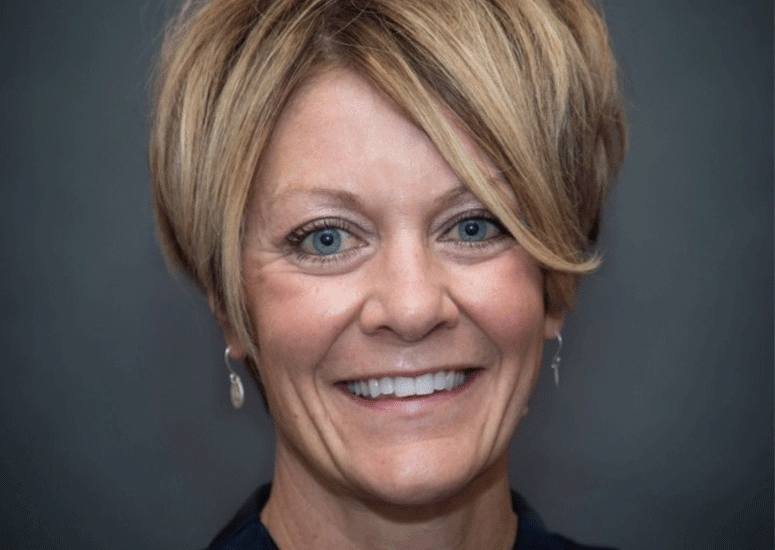
A year after she was finishing a two-year appointment at NCAR, Mercy Borbor Córdova was literally on the world stage, serving as a delegate from Ecuador at the Copenhagen climate summit.
At first glance, the Copenhagen conference seemed like an alternate universe—enormous, byzantine, and riddled with customs and folkways that weren’t at all obvious to someone who’s never been to such a meeting.
A group of scientists has put forth a new tool that combines four distinct measures of climate change into a single number—and the trend is clearly in one direction.
There was a palpable sense of history in the making across Europe as some 15,000 expected participants in the Copenhagen climate conference began to converge upon the Continent.
Margaret "Peggy" LeMone takes another stab at the challenge of showing that snow depth decreases at least in part because the snow “settles” and increases in density.
Even though reports continue to pour in about melting glaciers, sea ice loss, and temperatures across much of the globe remaining unusually warm, fewer and fewer Americans seem to believe the climate is warming.
Few other parts of the world are showing climatic trends as distinct and ominous as Australia’s—and these changes are broadly consistent with what climate models tell us the 21st century has in store for the continent.
Diplomats from almost 200 countries met in Copenhagen, Denmark, to huddle, confer, cajole, and eventually forge the structure of a new global agreement to reduce carbon emissions.
Every snowfall is different, including how much water is packed into the flakes and how that changes over the life of a storm. This can make it very hard to figure out how much snow “really” falls in a given storm.
The presence of El Niño boosts the odds of big Denver-area snowstorms, even though the region's winters as a whole aren’t substantially wetter during El Niño. It’s a good example of nuance in the relationship between El Niño and climate.
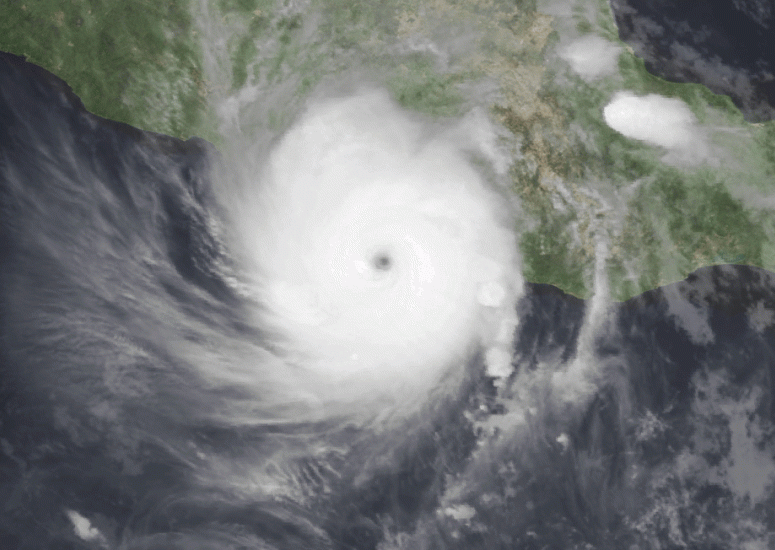
While most El Niños tend to inhibit Atlantic hurricanes, the Modoki variety, with its peak warming displaced further west from the Atlantic, appears to leave more room for a bumper crop in at least some years.
The public is keenly interested in the Sun and its doings. “Sunspots” is one of the most frequent search terms bringing visitors to the NCAR/UCAR website.
If you’re a gardener in New England, you might remember the wet, cool summer of 2009 for its tomatoes and potatoes, ravaged by the earliest and most widespread “late blight” on record. If you’re from south Texas, you were probably just trying to keep green things alive.
When our family bought our last car, we debated about the color, wondering if a white car would be cooler on our summer road trips across the American West than a darker-colored car. We ended up purchasing the white car. But was it for the right reason?
For Rana Fine at the University of Miami, this an exciting time for the UCAR community to be engaged in some of the most important issues facing our nation today.